
Established in 1947 to celebrate neuroanatomy and now promotes all of neuroscience.
Barbara L. Finlay
(1950–2026)
Development, Evolution, and the Architecture of the Brain
The Cajal Club mourns the passing of Barbara L. Finlay,
Ph.D., W.R. Kenan, Jr. Professor of Psychology Emerita at Cornell University and recipient of the Cajal Club’s 2024 Pinckney J. Harman Memorial Lecture. Dr. Finlay died on September 12, 2026, at the age of 75.
Finlay was a highly influential and innovative neurobiologist for over 40 years studying brain development and evolution. In her research, she brought together many areas including developmental neurobiology, comparative neuroanatomy, evolution, cognition, and computation to tackle the basic question of how evolution could build and modify a brain.
Finlay’s work challenged conventional assumptions that the evolution of larger and more complex brains could be understood primarily as the independent enlargement or specialization of individual brain regions. In landmark research with Richard Darlington, she demonstrated that the sizes of major structures across mammalian brains vary together in highly predictable ways and that these patterns are closely related to the conserved sequence in which neural structures develop. Brain regions generated later in development, including the cerebral cortex, tend to become disproportionately large as overall brain size increases.
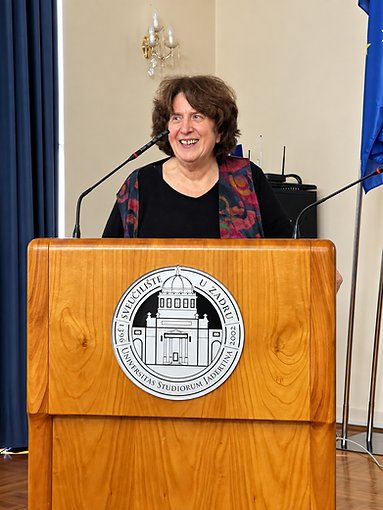
In this section: Portrait of Dr. Barbara L. Finaly, delivering the Pinckney Harman Award Lecture at the 2024 Evolution and Development of the Nervous Systems Conference, Zadar, Croatia. Photograph by John L. R. Rubenstein.
These findings helped establish development itself as a powerful organizing force in brain evolution. Rather than viewing the cerebral cortex simply as a collection of independently evolved, functionally specialized modules, Finlay explored the cortex as a flexible and increasingly differentiated structure whose organization emerges through conserved developmental processes, physical constraints, experience, and activity. Her work consequently opened broader questions about the evolution of human cognition and the relationship between brain structure and behavior.
Finlay joined the Cornell University faculty in 1976. The same year she received her Ph.D. in Brain and Cognitive Sciences from the Massachusetts Institute of Technology where her initial research was focused on the developing visual system and optic nerve. Her subsequent research spanned the domains of developmental and evolutionary neuroscience. Finlay authored many publications including serving as Chair of the Department of Psychology as well as Director of Graduate Studies. She also served as an editor for the journal Behavioral and Brain Sciences for over twenty years. A Fellow of the American Association for the Advancement of Science and the Association for Psychological Science, Finlay received these honors in recognition of her work.

Former Cajal Club President, Leah Krubitzer with Barbara L. Finaly at the 2024 Evolution and Development of the Nervous Systems Conference dinner, Zadar, Croatia.
Her intellectual curiosity was notably interdisciplinary. During her 2002–2003 fellowship at the Wissenschaftskolleg zu Berlin, Finlay described her work as linking molecular biology, comparative neuroanatomy, comparative behavior, allometry, anthropology, cognition, and modeling. Her research continued to explore these connections throughout her career, including later work examining how cortical areas may emerge through developmental processes and activity-driven organization.
The Cajal Club honored Finlay with the 2023–2024 Pinckney J. Harman Memorial Lecture, recognizing her extraordinary contributions to understanding the evolution of the cerebral cortex and nervous system. She delivered the lecture in September 2024 during the Evolution and Development of the Nervous Systems Conference at the University of Zadar in Croatia, where colleagues from around the world gathered to discuss the development and evolution of the brain.

Current Cajal Club President, Nenad Šestan with Barbara L. Finaly at the 2024 Evolution and Development of the Nervous Systems Conference dinner, Zadar, Croatia.
Finlay was remembered by colleagues at Cornell not only for the originality of her science, but also for her intellectual independence, generosity, mentorship, and willingness to challenge established assumptions. Alexander Ophir, chair of Cornell’s Department of Psychology, described her as a “maverick” and a “true visionary” who continually pushed the scientific community to think more deeply about the origins of brain function.
Barbara Finlay leaves an enduring legacy in developmental and evolutionary neuroscience. Her work encouraged scientists to reconsider what constitutes an evolutionary change in the brain and to recognize development not simply as the process through which an evolved brain is constructed, but as one of the fundamental forces shaping the possibilities of brain evolution itself.
The Cajal Club extends its deepest condolences to Dr. Finlay’s family, friends, colleagues, students, and the many scientists influenced by her life and work.
By Dawn Hunter, September 2026